|
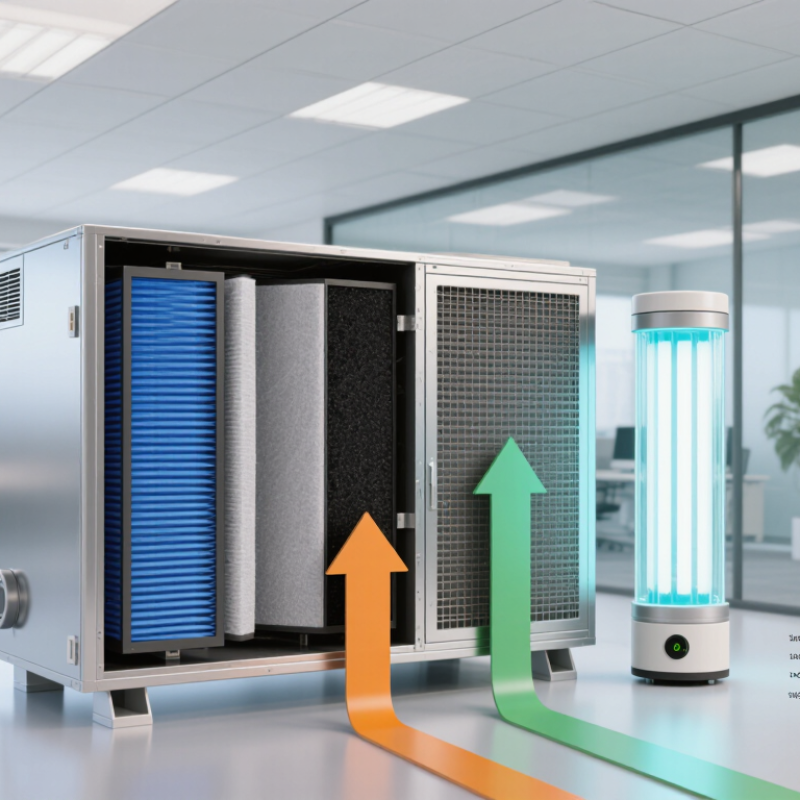
Central HVAC with MERV 13–14 Filters
|
Offices, schools, retail spaces, hotels, and multi-zone commercial buildings with central air-handling units.
|
MERV rating under ANSI/ASHRAE Standard 52.2. Verify the filter’s tested performance and pressure drop at the actual design airflow.
|
MERV 13 filters are tested for strong removal of particles in the approximately 1–3 µm and 3–10 µm ranges. MERV 14 provides higher minimum efficiency than MERV 13 across the tested particle-size ranges.
|
Increases the filtration portion of equivalent clean airflow when the HVAC fan can maintain the required outdoor-air and recirculated-airflow rates. Useful as a baseline control measure in an infection-risk-management plan.
|
Higher-efficiency filters generally create more resistance than lower-efficiency filters. Confirm fan capacity, coil performance, filter rack sealing, and airflow after installation.
|
Inspect regularly and replace when the manufacturer’s pressure-drop limit or the facility’s maintenance limit is reached. Prevent bypass around the filter frame.
|
A strong default for commercial HVAC systems when the equipment can accommodate the added pressure drop without reducing airflow.
|
|
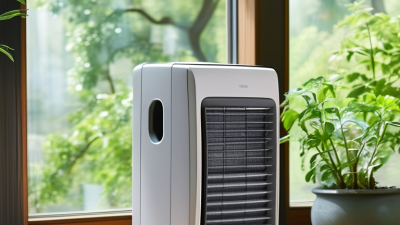
Portable HEPA Air Cleaners
|
Offices, classrooms, meeting rooms, clinics, reception areas, and spaces where central HVAC upgrades are limited.
|
ASHRAE 52.2 MERV classification is normally not the primary purchasing metric for a complete portable unit. Use independently verified HEPA filter performance plus clean air delivery rate.
|
A true HEPA filter is commonly specified at a minimum efficiency of 99.97% for 0.3 µm particles under the applicable test method. Whole-unit performance also depends on fan flow and cabinet leakage.
|
Contributes directly to equivalent clean airflow through measured or estimated clean air delivery. The 241 evaluation should use the unit’s actual airflow, operating schedule, and room volume.
|
Select a unit with sufficient airflow for the room and acceptable sound levels. Place it so air is not blocked and so the discharge does not short-circuit directly into the intake.
|
Replace HEPA and prefilters according to pressure drop, operating hours, contamination level, and manufacturer instructions. Clean exterior grilles and verify fan operation.
|
One of the fastest retrofit options for occupied spaces, especially when room-level airflow and noise requirements are clearly documented.
|
|
Dedicated Outdoor Air System with MERV 13–14 Filtration
|
New commercial buildings, laboratories, schools, healthcare support areas, and buildings requiring controlled outdoor-air ventilation.
|
Use MERV rating, initial and final pressure drop, airflow, and filter fit. ASHRAE 52.2 results should be reviewed together with the system’s outdoor-air delivery rate.
|
Provides particle filtration while delivering outdoor air. Actual indoor-air benefit depends on outdoor-air quantity, indoor mixing, occupancy, and the performance of downstream filters.
|
Supports the 241 equivalent-clean-air calculation through outdoor-air ventilation and filtration. This system can be especially valuable when outdoor air is intentionally increased during higher-risk operating modes.
|
Outdoor-air systems may experience substantial seasonal load and pressure changes. Confirm fan reserve, heating and cooling capacity, frost protection, and humidity control.
|
Monitor filter loading, outdoor-air dampers, sensors, coils, condensate management, and ventilation rates. Commission the system after seasonal changes.
|
Preferable where infection-risk modes require dependable outdoor-air delivery rather than relying only on recirculated-air filtration.
|
|
In-Duct HEPA Filtration Module
|
High-risk rooms, procedure areas, isolation-support spaces, clean manufacturing zones, and specialized facilities designed for high filtration efficiency.
|
HEPA performance is typically specified by the applicable product and installation standard rather than by a MERV rating alone. Confirm the complete module’s tested efficiency and leakage-control requirements.
|
HEPA media commonly provides at least 99.97% efficiency at the most penetrating particle size near 0.3 µm, but the installed assembly must also control frame, gasket, and housing bypass.
|
Can provide substantial equivalent clean airflow when the module’s actual airflow and efficiency are included in the 241 calculation. It does not replace required outdoor-air ventilation or pressure relationships.
|
High pressure drop may require a dedicated fan, larger filter area, or reduced airflow. Confirm structural support, access clearance, fan heat, and system balancing.
|
Use differential-pressure monitoring, planned replacement procedures, gasket inspection, and controlled handling of loaded filters.
|
Select for specialized or high-risk applications where the building can support the energy, space, and maintenance requirements.
|
|
Fan Filter Units and Ceiling-Mounted HEPA Units
|
Open-plan offices, classrooms, laboratories, manufacturing areas, and rooms needing distributed air cleaning without major ductwork changes.
|
Specify HEPA efficiency or the applicable tested filtration efficiency, together with airflow, noise, and whole-unit leakage information. Do not assume a portable unit’s performance from media efficiency alone.
|
Can provide high-efficiency particle removal when the complete unit is properly sealed and operated at its rated airflow. Room-level results depend on unit quantity, placement, and air distribution.
|
Adds distributed equivalent clean airflow under ASHRAE 241 planning calculations. Multiple smaller units can improve coverage where one large unit would create uneven mixing or excessive noise.
|
Check ceiling loading, service access, electrical demand, fan sound power, and potential drafts. Avoid placing units where supply and return air immediately recirculate locally.
|
Inspect filters, fans, grilles, controls, and mounting hardware. Use pressure-drop or runtime-based replacement criteria.
|
A practical choice for large rooms with zoning needs or difficult duct layouts, provided air distribution is commissioned.
|
|
Ultraviolet Germicidal Irradiation with Filtration
|
Air-handling units, upper-room applications, high-occupancy areas, and facilities seeking an additional biological-control layer.
|
UVGI is not rated by MERV. Use the air-cleaning system’s filtration MERV rating separately, and specify UV dose, irradiance, exposure time, airflow, and validated target-organism performance.
|
UVGI inactivates susceptible microorganisms rather than physically removing particles. Performance varies with UV dose, humidity, lamp aging, airflow pattern, and exposure time.
|
ASHRAE 241 calculations should use only a documented equivalent-clean-air credit supported by the system design and performance evidence. UVGI should supplement, not replace, ventilation and filtration.
|
Requires electrical power, safety interlocks, shielding, lamp access, and adequate exposure. Air velocity and duct geometry must support the specified dose.
|
Clean lamps and reflectors, verify irradiance, replace lamps based on rated output rather than visual brightness, and inspect safety controls.
|
Consider as a supplementary control where biological inactivation is needed and the installation can be safely validated.
|
|
Electrostatic or Electronic Air Cleaner with Mechanical Prefilter
|
Commercial buildings prioritizing reusable collection sections, moderate particle control, or reduced filter-media waste.
|
Review the complete unit’s ASHRAE 52.2 efficiency data, ozone emissions, pressure drop, and performance after loading. Do not rely on initial efficiency alone.
|
Particle collection efficiency can vary with particle size, electrical field condition, airflow, dust loading, and cleaning quality. A mechanical prefilter is commonly used to protect the collection section.
|
May contribute to equivalent clean airflow if the tested whole-unit efficiency and actual airflow are documented. ASHRAE 241 planning should account for downtime and reduced performance when maintenance is missed.
|
Usually has lower initial pressure drop than some high-efficiency mechanical filters, but electrical consumption and airflow effects must be evaluated. Verify ozone compliance.
|
Requires regular cleaning, electrical inspection, prefilter replacement, and verification of collection-cell operation.
|
Use only when maintenance capability, ozone performance, and whole-unit test data are clearly documented.
|
|
MERV 8–11 Filtration for Low-Load or Pre-Filter Stages
|
Pre-filtration, lightly occupied utility areas, equipment protection, and systems where fan capacity is severely constrained.
|
MERV 8–11 under ASHRAE 52.2, with the exact rating selected according to particle-size performance and pressure-drop limits.
|
Provides less fine-particle removal than MERV 13–14. Performance may be useful as a prefilter but is generally weaker as the sole infection-risk control in densely occupied spaces.
|
Provides a smaller equivalent-clean-air contribution than higher-efficiency filtration at the same airflow. The 241 plan should not treat this option as equivalent to MERV 13–14 or HEPA filtration.
|
Lower resistance can help preserve design airflow and reduce fan energy, but the trade-off is lower fine-particle removal.
|
Replace before excessive loading reduces airflow. Use as a protective stage upstream of higher-efficiency filters where appropriate.
|
Select mainly for pre-filtration or constrained systems; upgrade when occupancy, risk, or ventilation objectives require stronger particle control.
|